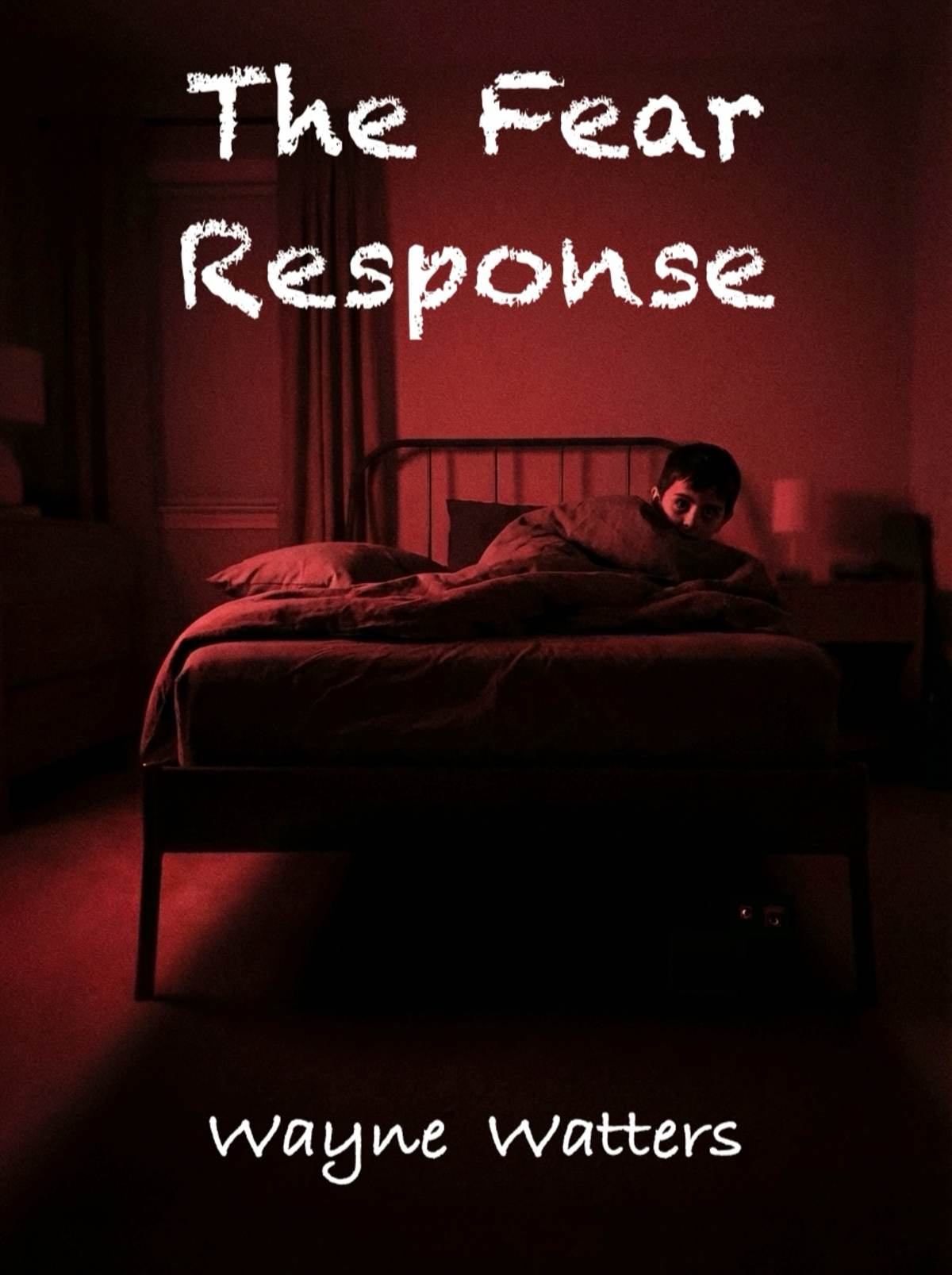
Most children don’t remember when the fear begins. It arrives fully formed, as if waiting for them. One night, the room is just a room. The next, the space beneath the bed has weight to it. It’s more than the darkness. It feels like presence.
It showed up in the body before it ever formed a thought. A tightening across the shoulders that pulled inward, a chill along the spine that made stillness feel exposed. Even before you understood why, you adjusted and centered.
I remember the rules before I remember questioning them. Don’t let your arm hang over the side. Don’t stretch your foot past the edge. If something falls, leave it. Morning will come, and it will still be there. These weren’t things my parents taught me. They were already in place, unquestioned, like the instinct to recoil from a sudden drop, or the unease of something moving just beyond your line of sight.
It happened in the minutes just before sleep, when the room started to recede and your awareness narrowed to what was closest to your body. The ceiling faded first. Then the walls. What remained was the edge of the mattress and the space just beyond it. That boundary sharpened as everything else softened.
I remember one night clearly, though I couldn’t say how old I was. Old enough to know the rules, young enough not to question them. The room was quiet and still. The light from the hallway had thinned into a narrow strip across the floor and stopped just short of the bed.
I lay in bed without moving, quietly watching that line, aware of where it ended. The darkness beyond it held its shape. I wished so strongly that the darkness would fade into the rest of the room. I wanted the light to be strong enough to take the darkness away from under the bed. I was too afraid to look.
Something had fallen earlier. I could still see it on the floor, easily within reach if I leaned over. Close enough that I knew exactly where it was without needing to look directly at it.
I didn’t move.
The thought of reaching down brought the feeling back immediately. It settled into place the way it always did, pulling inward. My body adjusted before I made a decision. I shifted toward the center of the mattress, drawing my arms in, reducing how much of me extended toward the edge.
I pulled the covers up with a slow and steady movement until they rested higher across my neck, as if that alone defined where I ended and the rest of the room began.
I kept my eyes open. That felt important at the time. Watching the edge, trying not to stare at the darkness. Wishing the line of light to stretch to the place where the floor disappeared from view.
The feeling stayed with me. It held its position, the same way the darkness did.
I understood the rule. Stay where you are. Don’t reach. Don’t extend beyond the edge.
After a while, the tension settled into something manageable. As long as I stayed centered, it remained where it was.
I fell asleep like that, aware of the boundary and the space just beyond it. Certain in a way I couldn’t explain, that the distance between the two mattered.
— ✶ —
What unsettled me years later wasn’t the fear itself. It was how specific it was. Children don’t scan the whole room. They don’t sit up and check the door or the window. They look at one place. The same place. And even when they pull the covers tight, even when they squeeze their eyes shut, they keep part of their attention angled downward, toward the narrow strip of darkness just below the bed.
Sitting up never helped. It made things worse. Sitting up exposed you. It widened the room, broke the boundary, made you visible in a way that felt wrong. Curling inward reduced you. Contained you. It felt less like hiding and more like aligning with safety or protection.
I used to think it was imagination filling in the unknown. That’s what I was told, and it made sense in the way simple answers do. The mind dislikes empty space. It invents shapes, assigns intent, turns shadows into something worth fearing. That explanation holds, right up until you start asking why the mind chooses that space at all.
I remember waking up once and my hand had stretched out past the edge. My mind immediately screamed for me to pull it back in under the covers. But it was like I was paralyzed. I was too afraid to pull it back. What if that triggered the gremlin, or the witch, or whatever it was that owned the darkness. I didn’t want to wake it, so I held my hand there, past the edge, hung in open air.
The feeling of danger or exposure was overwhelming. I know I held it there longer than I should. It’s like I didn’t know what else to do. It felt like an hour, but eventually I pulled it back under the covers. Slowly. One inch at a time. Holding my breath so there was no noise.
Nothing touched me. Nothing moved. Once my hand was back under the covers, the feeling changed. The anxiety relaxed immediately. Just returning it to where it belonged.
A thought occurred to me more recently. The stories never included what happened next. No one ever claimed the thing under the bed reached up. No one described being pulled down, or taken, or even touched. The fear was always anticipatory. As if the danger wasn’t in what it might do, but in the possibility that it might already be doing something you couldn’t see.
The first time I considered that the fear might be misplaced, I dismissed it almost immediately. It made sense. Evolution doesn’t preserve futile instincts. It refines them, embeds them, carries them forward long after the original conditions have changed. A fear that appears early, crosses cultures, and requires no teaching isn’t random. It’s residue.
It seems to me the instinct was never about the room. It was never about the dark. It was always directional.
— ✶ —
As I got older, I realize the instinct never left. It settled into the background. I sleep normally. I move through rooms without noticing where my attention settles. Whatever had been there in childhood felt contained by distance and time.
But it came back in fragments. A conversation at first. Someone describing a childhood fear in the way people do when they’ve already decided it was irrational. Dismissed before it’s fully explained.
“I used to hate letting my feet hang off the edge of the bed.”
There was nothing unusual in that. I’d heard it before. Everyone had. But something in the way it was said caught my attention. There was precision in it.
I asked a few questions, more out of habit than interest. When did it start? When did it stop? What exactly did it feel like?
The answers were consistent in a way that felt rehearsed. No one remembered learning it. No one remembered being told. The rules were just there. Fully formed.
And the behavior that followed them was the same. Pull inward. Stay centered. Avoid the edge.
I tried to let it go after that. It didn’t feel significant. Not yet. Just a familiar pattern is all.
Until it showed up again. I was sitting in the union building on campus, working through notes for my psychology class, when a group of students at the next table started talking about their childhood fears. It wasn’t a serious conversation. It was more like a list of things that used to matter and no longer did.
One of them mentioned the space under the bed. I expected to hear jokes, bit the others accepted it without question. In fact, they added to it.
“Yeah, I used to make sure my arms were under the blanket.”
“I wouldn’t get up if I dropped something.”
“I hated that part where your foot gets close to the edge.”
They described it the same way. Not in general terms. There were rules, boundaries, and specific adjustments made without instruction.
I sat there and listened, letting the conversation run without interrupting, paying attention to how easily they agreed on the same small rules.
Later that week, I asked my professor about it. I framed it as a question about early childhood fear responses. Asking how they form, whether they’re learned or inherited, how consistent they are across different environments.
She gave me the expected answer. “Most early fears are adaptive. Heights, sudden movement, large animals. Things that would have posed a real threat in early human environments.”
“And the ones that don’t?” I asked.
“Those are usually developmental,” she answered. “Pattern recognition overshooting its mark. The brain filling in gaps where it doesn’t have enough information.”
It was a clean explanation. It accounted for everything on the surface, but it failed to account for the consistency.
I started paying closer attention after that. Listening for it when it came up, which it did more often than I expected. Different people. Different backgrounds. Same structure.
The fear wasn’t described as an image. No one agreed on what might be under the bed. That part varied or disappeared entirely with age. What didn’t vary was the behavior. No one wanted to extend beyond the edge, and no one remembered why.
I found a few references that came close to describing it. Sleep studies that mentioned “edge aversion” and fears of the dark in children. A line or two in broader discussions about sleep posture. The literature didn’t really dismiss it. It catalogued it. Nighttime fear was common, even predictable. The objects of that fear changed with age, but the structure remained.
I reached further into the literature. I found anthropological notes on early human sleeping arrangements where it was believed groups slept in clusters, avoided exposed positions, and preferred elevated sleeping areas when possible. The research didn’t mention the edge directly. It focused on exposure. Where the body rested in relation to what surrounded it. The patterns were consistent in describing that the position mattered.
All reasonable, but none of it explained why the edge felt different. Nothing justified the fear. I found no consistent report of harm. The fear existed in isolation, detached from consequence.
That should have made it easier to dismiss. Evolution doesn’t preserve empty signals. Not with that level of consistency or across generations. A response without an outcome either fades or adapts. It doesn’t remain intact.
Unless the outcome isn’t being recognized.
If there was a pattern, there had to be a variable that hadn’t been accounted for. Something present when the fear was strongest.
For a while, nothing surfaced. Then I came across a case that didn’t fit the rest. It was a brief mention in a collection of sleep-related incidents. A parent describing a child who refused to sleep near the edge of the bed. Persistent. Unusual for their age.
The detail that stood out wasn’t the fear. It was the timing. The behavior had intensified over a period of several nights, then stopped abruptly without explanation or intervention.
Included in the account, almost as an afterthought, was a note from the parent. During that same period, there had been repeated reports of someone attempting to access homes in the neighborhood. Doors tested. Windows checked. No confirmed entries.
The incidents stopped the same night the child’s behavior returned to normal. There was no connection suggested in the report. No reason to assume one. But it was the first time I had seen the fear align with something else.
— ✶ —
The case should have resolved it.
To the contrary, it made the pattern harder to ignore. It introduced alignment where there shouldn’t have been any. A coincidence, on its own, is meaningless. But once you notice one, you start looking for others.
They weren’t difficult to find.
I began reviewing similar accounts, this time with a narrower focus. I was looking for timing. When it appeared. When it intensified. When it stopped.
The descriptions were familiar. A child insisting something was under the bed. Refusing to sleep. Refusing to reach down, even in full light. Parents checking, reassuring, sometimes humoring the fear by looking themselves.
Nothing was ever found. That part never changed.
What changed, occasionally, was everything around it. There were small things at first. Easy to overlook. A parent mentioning a broken latch on a back door that hadn’t been noticed before, with no clear point of failure in the latch mechanism. An animal getting into a garage and leaving no trace beyond disturbed storage, suggesting a brief presence that did not continue. A window left unlocked in a part of the house no one used regularly, found open in the morning with the interior undisturbed.
Individually, none of it carried weight. Normal events. Background noise.
But when placed next to the timing of the behavior, they began to overlap in ways that were difficult to dismiss. They aligned with a pattern of interruption, where something initiated and then ceased before completion.
The fear would spike for several nights. Then it would stop. And whatever had been forming in the background, whatever had been approaching without resolving, would stop with it, ending in a quiet cessation rather than a visible outcome.
There was never a clear outcome. No confirmed intrusion or interaction. A brief proximity followed by a consistent stop.
I went back to the original assumption. That the fear was predictive of threat. That model failed. If the fear were predictive, there would be outcomes. Escalation. Resolution. Some measurable consequence. There wasn’t.
The pattern didn’t follow events. It followed something else. Something that appeared, held position briefly, and then withdrew. And once it did, everything shifted. It seemed like the fear wasn’t anticipating something that might happen. It was responding to something that already was.
I started to reconsider the physical experience itself, and the sensation tied to it. The memory of it hadn’t changed. It had just been miscategorized. There was no urgency, no sense of movement or approach. Nothing closing the distance.
It was quieter than that. More stable. Like entering a room and knowing, without looking, that someone else is already inside.
The space under the bed felt occupied.
I considered that the instinct wasn’t reacting to something approaching. It was reacting to something already present. That realization reframed the outcome entirely. The pattern consistently resolved through cessation, indicating that the presence itself influenced what followed.
— ✶ —
At some point, the pattern stopped feeling isolated.
It wasn’t just the accounts I had been reading or the conversations I had been listening to. The structure started showing up in places that had nothing to do with childhood fear or sleep at all. Older references. Fragments of explanation that had been carried forward without much scrutiny.
I didn’t go looking for it directly. It surfaced by coincidence the way everything else had. Then it appeared often enough that it stopped feeling like chance.
A passing mention in a lecture. A line in a text that wasn’t even part of the assigned reading. Something about early interpretations of presence and how different cultures had tried to describe the sense that something remained close without being seen.
The language varied, but the idea held. It was close and positioned.
I became aware of how often those descriptions avoided detail. They didn’t describe form or movement. They described function. A presence that stayed near. Something that intervened without being observed directly. Something that influenced outcomes without becoming part of them.
In one of the older Hebrew references, the word used was malakh—something closer to a messenger or intermediary than anything divine. The meaning was practical, grounded, describing something that moved between states or carried influence without remaining visible. In Greek texts, the term shifted to daimon, not the later interpretation of something sinister, but a guiding presence tied to a person, one that influenced direction without revealing itself. The Roman idea of a genius followed a similar structure, something attached to an individual or a place, present and near.
Different languages. Different interpretations. The same underlying structure.
The translations didn’t always help. Words that had once meant “messenger” or “intermediary” had been carried forward and elevated into something else entirely. Over time, they became distant, abstract, or removed from the physical spaces they might have originally described.
There were references to something assigned or attached, though not in a way that suggested ownership. More like alignment. A presence that remained in proximity, that registered changes, that responded without needing to be seen.
Other accounts placed it within the home itself. Not moving through it but holding a position within it. Tied to the structure. Tied to the space people occupied when they rested.
Different cultures, different interpretations. The same restraint in description.
No one described what it looked like. They described where it was and what happened when it was there.
That part was consistent. Events that didn’t fully develop. Conditions that shifted without clear cause. Moments where something seemed to begin and then failed to continue.
The same pattern I had been seeing.
I went back through my search history and my notes after that, this time reading them alongside those older references instead of separating them. The overlap wasn’t exact, but it didn’t need to be. The structure was enough.
A presence held position. It remained close. It influenced outcomes at the edge of interaction. And it did so without drawing attention to itself.
Once that alignment settled, the earlier assumption became harder to maintain. The idea that the space under the bed was empty no longer fit with the pattern. It required too many exceptions. Too many moments where something should have happened and didn’t.
The alternative was simpler. The space wasn’t empty. It was occupied in a way that had always been present but rarely acknowledged. A position that had been described in different terms, across different times, and then gradually abstracted into something less precise.
What we kept was the idea of protection.
What we lost was where it occurred and how close it had always been.
— ✶ —
Once that settled, the parallels stopped feeling abstract. The childhood response, the older references, and the way the room organizes itself at night began to read as parts of the same story rather than separate ideas.
The fear under the bed follows the same rules. It forms at the boundary, not across the room. It centers the body instead of sending it searching. It holds attention at a fixed line and keeps movement contained within it. That behavior echoes the descriptions in those earlier stories, where the presence remains close, positioned, and tied to a specific place rather than moving freely through it.
The differences come from interpretation. In childhood, the response feels like fear because there is no context for it. In the older texts, the same response is described as guidance or protection, because the outcome is observed over time. In both cases, the presence remains the same. What changes is how it's understood.
The environment explains the rest. Earlier living spaces carried more exposure. Open thresholds, shared boundaries, and sleeping positions that placed the body closer to the edge of the surrounding environment. In those conditions, a presence that held position near the point of contact would influence outcomes in a way that appeared consistent, even if the method remained unseen.
That same arrangement persists in a reduced form. The bed creates a defined boundary. The space beneath it maintains a fixed position relative to the body. The response forms along that line in the same way it always has, organizing posture and limiting extension beyond it.
It also explains why the instinct feels so specific. It isn’t just about staying away from the edge. It’s about staying within range. If something is holding position there, then it needs you to do the same. The adjustment isn’t just protective on your side; it keeps the interaction stable. The boundary only works if both sides hold it.
At that point it stopped feeling like three separate things. The instinct, the references, and the way the room feels at night all lined up. There’s something close, something that stays in the same place. It reacts when you get too close to the edge, and things seem to settle when you pull back. The body just kind of falls into that without thinking about it.
Seen together, the connection no longer requires interpretation. The childhood fear, the historical descriptions, and the structure of the room all point to the same ending. The presence that earlier cultures described in different terms remains where it has always been placed, within reach of the body, positioned at the edge where exposure begins.
What changed over time was our understanding of that presence. The language shifted. The context faded. The response remained.
And the space beneath the bed will continue to offer refuge to the guardian.