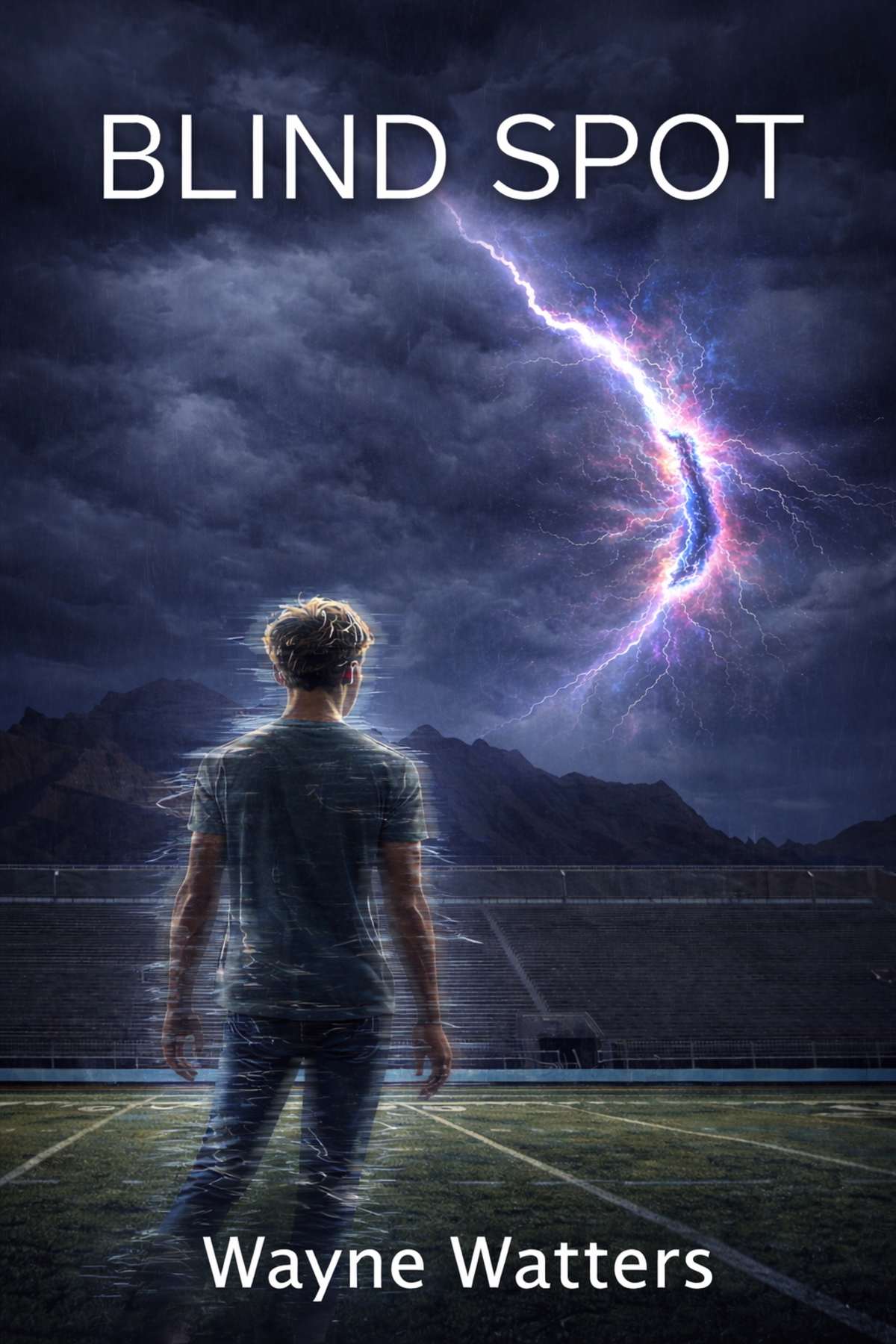
Something is brewing. A story has taken hold of me. The kind that wakes you up at 3:00 in the morning with a new idea, the kind that follows you into the grocery store, while you're alone in the car, and every quiet moment in between. I'm thrilled to share it with you today, even if only in pieces: I'm deep into a new manuscript, and it's called Blind Spot.
I'll start with what I can tell you, which is enough to give you a real taste. Hopefully, this will leave you wanting more.
The Story Begins with a Question
What if the act of watching something could change it?
That's not a metaphor. That's actual physics.
In quantum mechanics, there's a principle called the observer effect. At the subatomic level, particles don't commit to a single state. They exist as a spread of possibilities, a shimmer of potential. But the moment they're observed, something extraordinary happens. All of those possibilities collapse into one. A single reality locks into place.
Scientists continue to wrestle with this. It's strange, counterintuitive, and either a measurement artifact or something far more radical. Now, consider what it would mean if observation isn't passive. What if consciousness doesn't simply receive reality, but participates in creating it?
Blind Spot asks that question and then puts a twenty-two-year-old college student right in the middle of the answer.
Meet Eli
Eli Hatchette is a cognitive science and philosophy student at UT El Paso. He’s smart, perceptive, a little guarded, and carrying more than he lets on. He lives with a rare and heightened form of synesthesia, a condition where the senses don't stay in their lanes. Sound becomes color. Light becomes shape. A car alarm in a parking lot can send spirals of crimson and violet tearing across his vision.
Eli's synesthesia is different from the textbook kind. It didn't arrive gently, woven into childhood the way it is for most. It began with a single, shattering event. It was a night in his father's garage, an experiment gone wrong, a flash of light, and a six-year-old boy who collapsed and woke up seeing the world differently than anyone around him.
Now, years later, Eli is beginning to wonder if what he sees at the edges of reality is a symptom or a signal. The seams… the shimmers… the lightning that doesn't quite belong to the storm.
The Science Underneath
I've spent time with quantum physics, consciousness studies, and cosmology while writing this book, and the science is genuinely strange. That strangeness is the point.
Blind Spot is built on two scientific pillars, and together they open a door I've tried to walk through carefully and with real intention.
The first is the observer effect. In quantum mechanics, particles don't commit to a single state until they're observed. They exist as a cloud of possibilities that collapses into one reality the moment awareness touches them. Most scientists treat this as a measurement quirk. But a more radical interpretation asks whether consciousness itself participates in shaping what becomes real. Blind Spot takes that question seriously.
The second is Brane Cosmology. A theory from modern physics suggesting that our universe is not alone. Picture our entire reality as a thin membrane, or "brane," floating in a vast higher-dimensional space. Other branes — other universes — may exist parallel to ours, close enough to almost touch but invisible to us. They’re separated by a gap we have no instruments to measure... maybe.
What Blind Spot asks is this: what if those two ideas are connected? What if someone’s mind was wired in a particular way, allowing them to feel reality collapsing? What if that sensation could also be sensitive to what lies on the other side of the membrane? What if the tears in the air that Eli sees aren't symptoms? What if they're actual seams?
The science doesn't provide easy answers. Neither does the book. Both point toward the same unsettling possibility. The universe is far less solid and far more alive than any of us has been taught to believe.
What's at Stake
There's a mystery at the center of this story. One that begins in a campus lab late at night, where something inexplicable happens, and the world Eli thought he understood stops making sense.
What follows will challenge everything he believes about perception, reality, and himself. The closer he gets to answers, the more dangerous the questions become.
Some doors, once opened, don't close again.
A Word About Why This Story
This novel has been a long time coming. The seed of Blind Spot was planted in college, where it began as a short story. It was a single idea, a single character, a single question flickering at the edge of something larger. I didn't know then how far it would go.
But the science kept pulling me deeper. The characters kept demanding more space. And what started as a few pages quietly expanded into something I can only describe as captivating. It has been fun to write, to research, and to live inside. The deeper I dug into the science and characters, the more I realized the story I was trying to tell was bigger than a short story could hold.
Some books find you quickly. This one grew slowly and deliberately. I think that's made it stronger. And I can't wait for you to read it.
Stay Close
I'm not ready to announce a timeline yet. But I am ready to tell you that this book is alive and growing, and I think about it every day.
For now, just know this: something is in the works, and if you look at it from the corner of your eye, you might just catch a glimpse of it.